The founders winning on TikTok aren’t better at content. They’re running better systems.
The old model on influencer marketing made sense for its time. Scout an influencer. Ship samples. Brief a script. Wait two weeks. Hope the edit doesn’t suck. Pay $1000. Get two videos. Maybe one performs, that model worked when distribution was slower and still great ROI wise. But today, it’s slow to compete.
What the pattern actually looks like
we just built the largest ugc program ever. we hit 500m views in 60 days and it was all built by a 19 y/o kid.
— Tanay Kothari (@tankots) January 27, 2026
in july, i saw cluely hit 300m views in 90 days with ugc.
so i hired a 19-year-old student who'd been making content for three months to build out our ugc program.… pic.twitter.com/ntn7fda3Mt
The CEO of Wispr Flow recently shared how a 19-year-old scaled a UGC content engine to 500M+ views in under 60 days.
A few things made it work.
First, creators had real autonomy. Nearly half the content was fully free-form, their voice, their style, no brand script to follow. That’s what made it feel native.
Second, they built a replication loop. 70+ creators posting daily. The moment a video crossed 1M views, it became a template that gets pushed across the entire network immediately.
Third, the hooks were unusually specific.Like using a complex name like “Tchaikovsky” to demo the product in a way that feels organic, not salesy.
And I think the most important part is that they were ruthless about who got in. 1000 applicants and only 60 were selected.
The result was CPMs as low as $0.74. Massive organic reach. Real acquisition impact. Not because they got lucky once, but because they built a system that could repeat the luck.
How to build your own TikTok growth system
AI video tools got good enough to skip most of the old process. Tools like Runway, Kling can generate a starting point from a single product image.
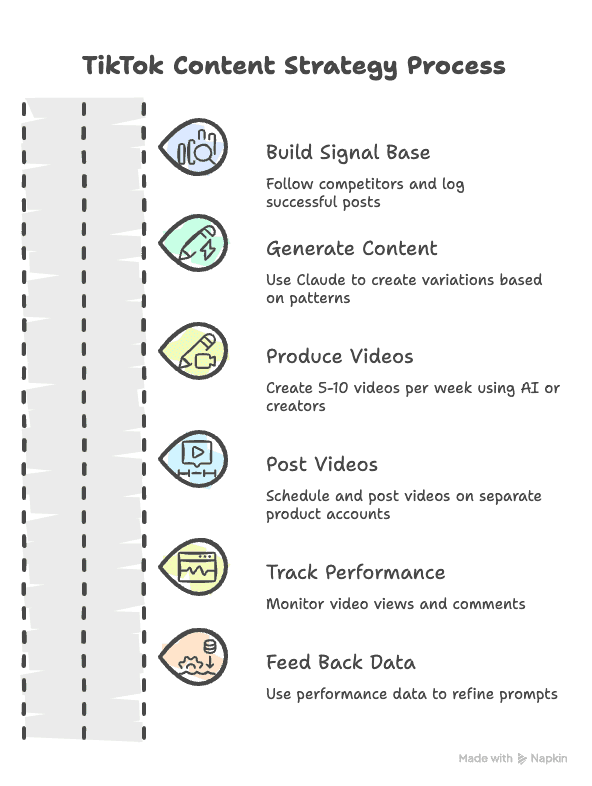
Step 1: Build your signal base
Follow your top 3–5 competitor TikTok accounts in your niche. Every time a post crosses 10k views, log it:
- Hook used (first 3 seconds - word for word)
- Format (text overlay, reaction)
- Audio (trending or original)
- View count and comment volume Do this in a Google Sheet or Notion. Run it for 30 days. You now have a pattern map, the actual formats and hooks your market responds to.
Step 2: Generate from that signal Take your top 3 performing patterns and feed them into Claude with your product context. Prompt it with the hook formula, the format, and your product details. Ask for 10 variations per pattern.
Step 3: Produce at volume Use AI tools to generate footage with AI generated humans talking or find creators who will be a good fit (this is a challenge for sure, but more agencies are onboarding creators so see if you can leverage that).. The target is 5-10 videos a week. Your first video won’t go viral. That’s fine. You’re looking for the pattern, not the spike.
Step 4: Post, track, feed back Run a fresh TikTok account per product, not one account for everything Schedule with Buffer or Later Track what crosses 5k views Feed those winners back into your prompts The loop gets smarter every cycle. Research → generate → produce → post → iterate.
P.S. Since at the end of the day these are botted accounts you follow basic practice of warming up the account i.e., engaging with other accounts daily. This can also be automated, cos 15-30 minutes a day per account might get repetitive.
The uncomfortable truth about UGC marketing
UGC works because it looks authentic and volume is what creates that effect at scale. One video is a coin flip. Twenty videos is a strategy. Eighty videos is a moat. You can’t learn what works from three videos a month. You can learn it fast from thirty.
The insight underneath all of it
Most consumer tech apps have the product. They have a story. What they’re missing is volume. Not budget. Not a bigger team. Just more shots. The only real question: how many are you taking per week and what’s stopping you from doubling it?